Why Birds Matter
The chickadee outside your window is not just a backyard visitor—it’s a beautifully adapted dinosaur descendant!
Yes, dinosaurs live; and we see them every day. We simply call them birds. Our birds—flying, hopping, paddling and running—evolved from small, feathered dinosaurs more than 150 million years ago.
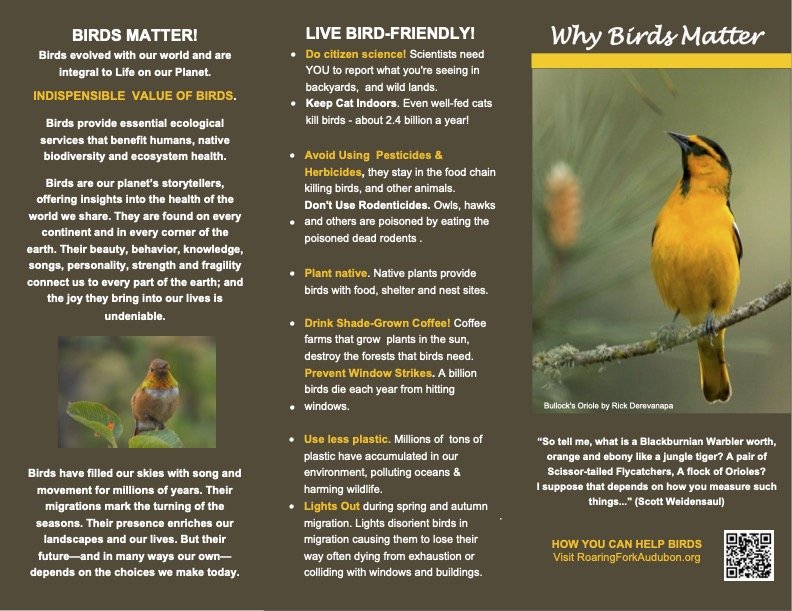
Birds are our planet’s storytellers, offering insights into the health of the world we share. They are found on every continent and in every corner of the earth. Their beauty, behavior, knowledge, songs, personality, strength and fragility connect us to every part of the earth; and the joy they bring into our lives is undeniable.
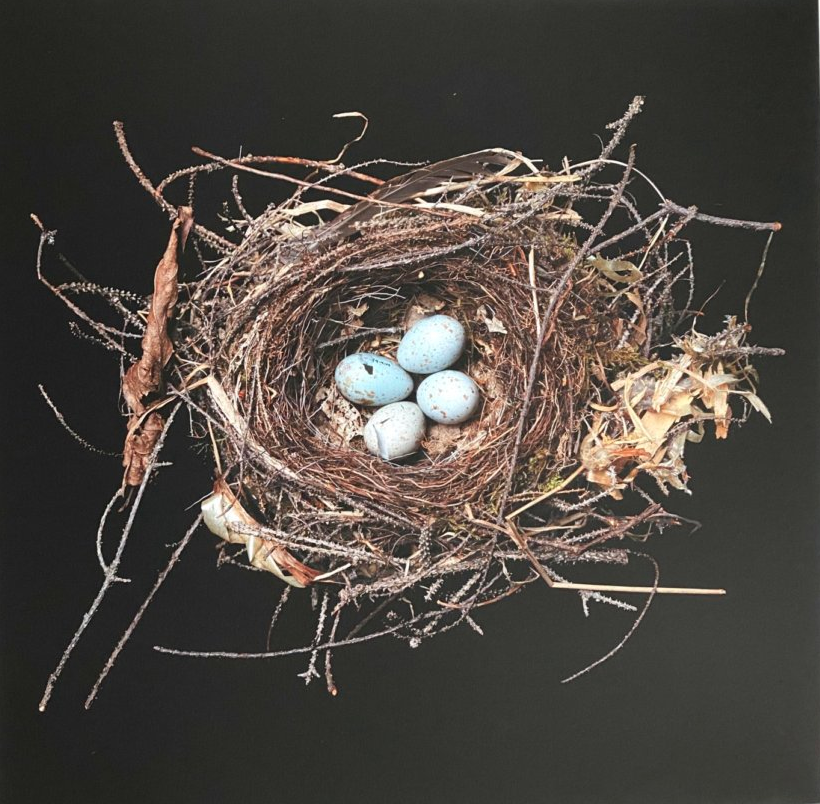
They live in extreme environments and are capable of incredible physical feats like flying over the Himalayas or non-stop over oceans for thousands of miles, some flying for months without stopping. With millions of years more evolution than humans and outnumbering mammal species by more than two to one, their advanced brains are capable of memorizing 80,000 locations with almost perfect recall and learning song and dance that many may still believe is limited to humans. As dinosaurs, having survived several mass extinctions, they remind us of how resilient they are. Like us, they build intricate homes from twigs and spider silk, raise and educate families in them, engage in complex play activity and even take long winter vacations in warm places, reminding us how like us they seem to be.
How do we measure their value, and what can they do for us?
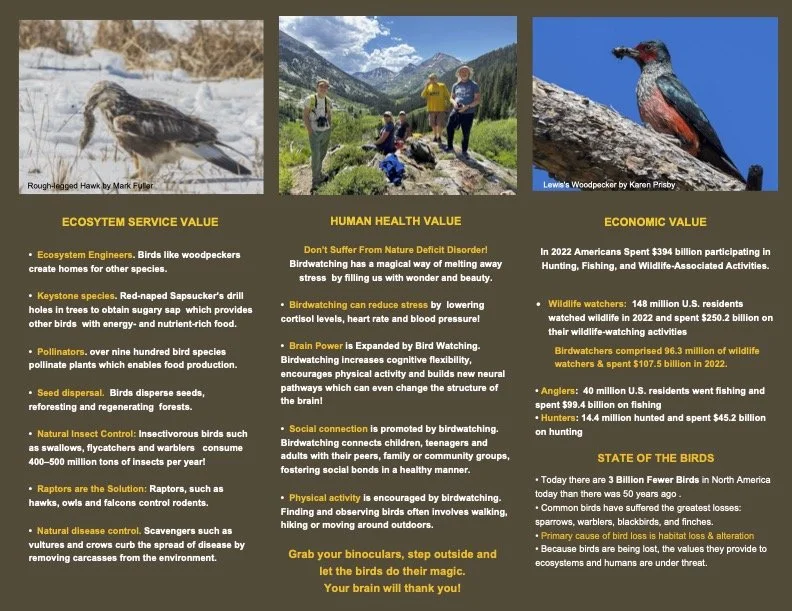
Some birds eat insects and rodents, some clean our environment by eating dead animals, many birds pollinate plants and spread seeds, keep our ecosystems healthy, develop our brains, support mental health and help the economy. Even though they are crucial to our ecosystems, it’s not just what they do for the environment, it’s what they do for humanity.
Birds’ ecological roles are critical to the health of many ecosystems and to human well-being.
Pollinators: Many birds pollinate plants; and our heroic hummingbirds can visit as many as 2,000 flowers a day, ensuring the propagation of many species of plants.
Seed eaters: Finches, sparrows and other seed eaters spread seeds as they travel, helping forests and other plant life to expand. Birds ingest fleshy fruits, fly elsewhere and excrete seeds along with ready-made fertilizer. Some plants are totally dependent on this strategy for dispersal, providing seeds, some of which are sticky after passing through the bird’s gut. Plants also use birds’ feet and feathers in a process known as Adhesive Seed Dispersal. Birds unwittingly carry these seeds as a free courier for the plants.
Seed planters: Some birds actively plant seeds to survive; and, in turn, some propagate into new trees for our forests. The Clark’s Nutcracker may win the prize for forest restoration after a burn. Each bird can bury up to 80,000 seeds at just the right depth to sprout. The ones they forget about retrieving to eat become next-generation trees.
Insect eaters: Almost all our birds work 24/7, day and night, making sure insects do not overcome our native plants, saving entire forests on a constant basis. Swallows and nighthawks eat millions of mosquitos every evening; and warblers and other birds work non-stop on every leaf, stem and trunk, eating 40% of all insects and 98% of all tree budworms. As they eat insects and other small organisms, depositing waste, birds help return essential nutrients to the soil, promoting plant growth.
Pesticide reduction: Birds eat large numbers of insects that would otherwise damage crops and vegetation. This reduces the need for pesticides that can contaminate water sources. This also saves farmers millions of dollars a year in toxic pesticide products.
Rodent control: Rodent-eating birds, such as hawks, owls and falcons, help control rodent populations as a natural form of pest management.
Toxins control: Turkey Vultures are a major contributor to our biodiversity. Without them, human health would be compromised. They have historically curbed cases of rabies, anthrax and other zoonotic diseases in humans. If anthrax bacteria and cholera viruses pass through the gut of a fox or a coyote, they’re still serious; if they pass through a vulture, they instantly lose their lethality. Vultures cleanse the land like little else! Their scientific name, Cathartes aura, means cleansing breeze.
Recreational and economic contributions: Birdwatching is a rapidly growing hobby that generates billions of dollars annually in the U.S. through spending on gear, travel and lodging, creating jobs and supporting local economies.
Bird studies help us advance scientifically.
They teach us about climate and the environment. Birds are also key to indicating environmental changes. Large, rapid bird declines alert us to an environmental problem that needs immediate attention. They are literally our canaries in the coal mine.
Eagles and Peregrine Falcons warned us about DDT.
Common Loons warned us about mercury in our water.
Passenger Pigeons warned us about overhunting. Now they’re extinct.
California Condors and Bald and Golden Eagles are warning us of lead poisoning due to the use of lead bullets.
Mental health—don’t suffer from nature deficit disorder.
Birdwatching has a magical way of melting away stress and anxiety. Imagine this: you’re out in nature and you hear birds chirping. Suddenly, your worries about that looming deadline or the never-ending to-do list start to fade. That’s not just a pleasant daydream—it’s backed by science.
Studies in environmental psychology have shown that observing birds can significantly lower cortisol levels, heart rate and blood pressure—all indicators of stress. It is a fantastic and scientifically-proven way to help improve mental health, reducing symptoms of depression, stress and anxiety. It’s peaceful, it’s meditative and it might be the best thing you can do for your overworked mind. It triggers the release of dopamine and serotonin, the brain’s feel-good chemicals, leaving you calmer, more centered and able to carry these benefits back into daily life.
Science shows that birdwatching is like a nature-filled therapy session that can transmit into neighborhoods that host a larger number of bird species.
Birds fill us with wonder. They motivate us to learn, to explore and to connect with others. They also provide a connection to the natural world, adding color, sound and joy to our lives and reminding us to appreciate the world around us. Studying the plants and animals in an intact habitat is an ongoing lifetime gift that never gets boring. You understand this world. You can take all the time you want to indulge your sense of wonder, to spy on critters and investigate flowers and ants and learn how they all connect. All ages benefit from time slowly walking, sitting or hiding in nature, especially the younger generation that needs this activity to escape the constant barrage from electronic screens.
Birdwatching promotes social connection when it is a shared activity. This in turn connects children, teenagers and adults with their peers, family or community groups, fostering social bonds in a healthy manner. The camaraderie of shared experience and joy in other people’s joy is an antidote to the sense of isolation and conflict often experienced by our young online or in other contexts. Reminders of joyful, shared humanity can feel restorative.
The excitement never goes away; and, as long as you can get into nature, the saying will hold true that life is not measured by the number of breaths we take but by the moments that take our breath away.
Brain power is expanded by bird watching.
Neuroscientists agree with the overwhelming clinical evidence that demonstrates a variety of positive benefits from studying birds in and out of the field. These studies also show time moving quickly through the outdoors does not transmit the benefits like time spent slowly observing and studying. This knowledge of the many different components of our natural world will empower our children.
Improves attention and memory: Focusing on identifying birds and their intricate and highly individual behavioral messages, including the variety of vocals, strengthens attention spans, which can be weakened by overstimulation from fast-paced daily life. “What kind of bird is that?” The moment you ask that question, your brain shifts gears into curiosity mode.
Builds brains: The practice of identifying different species and even sub-species that share the same basic features can increase cognitive flexibility and build new neural pathways. Over time, expertise can change the structure of the brain. Parts of the cerebral cortex may become slightly thicker as a person’s visual and auditory proficiency deepens. This makes it easier for birders to add new information to their mental repertoire, says Erik Wing, a neuroscientist at Rotman Research Institute in Canada. This makes learning easier and quicker and may improve retention of knowledge. Kids especially reap the benefits of expanded brain power and enhanced problem-solving skills. How fast does a Peregrine Falcon fly? How far does a Bar-tailed Godwit migrate without stopping? What color and size of bill does this bird have? Of the 258 or so birds in the Roaring Fork Watershed, which song or call is that I hear? What does this species eat, and how does it create its nest? When do our migrant species arrive, and where do they come from? Using critical thinking and observation skills to piece together clues of subtle identification details, behaviors and surrounding habitats changes mental scaffolding, literally rewiring the brain; and that translates to all subjects in school and life for our children—reading, writing, language, science, history and outdoor education. All this, while having enjoyable and emotionally healthy days, unsuspectedly advances their brain capacity.
Boosts creativity: Learning about birds and their environments can spark creativity and provide a different way to learn and engage with school subjects, such as science. Contributing to citizen science by submitting observations to scientists trying to understand what is happening to our wildlife encourages volunteerism.
Improves attention span: Tracking a flitting bird through a binocular or scanning tree branches for movement is like a workout for your attention span. Bird watching hones your ability to focus on a single task—a skill that’s invaluable when life feels like a million tabs open at once.
Physical and developmental benefits abound.
Encourages physical activity: Finding and observing birds often involves walking, hiking or moving around outdoors, which can inspire more physical activity than sedentary hobbies.
Fosters environmental stewardship: Becoming knowledgeable about birds can lead to increased interest in conservation and environmentalism, important topics for the future.
Boosts self-esteem: Children who may not excel in traditional academic settings can find a sense of expertise and confidence through birdwatching, where they can be the expert on a particular topic.
So, grab that binocular, step outside and let the birds do their magic. Your brain will thank you.
How can we help? How can we ensure that these modern dinosaurs that have survived so many mass extinctions are not doomed because of our abuse and indifference?
The future of most bird species depends on our commitment to preserve them. Are they valuable enough for us to make the effort?
Nearly 60 years ago, Rachel Carson’s bleak warning of a spring devoid of bird song launched the modern environmental movement. Since that warning, we have lost more than one-third of our birds!
On average, 144 species of birds go extinct every year.
The rate of bird extinctions is faster now than at any time since a huge asteroid struck the earth 65 million years ago.
Migratory birds are now compressing (and shrinking) their breeding ranges due to habitat loss and climate change.
Half our birds are in serious decline, and some are at a tipping point for existence.
Activism and helping to spread the word are the best ways you can make a difference. We must not become too depressed about how humans are destroying our native animals; instead, use your knowledge to influence others to become aware and to make a difference. Visit roaringforkaudubon.org to find more ways to make a difference.
Saving habitats for our native animals is imperative. This is the number one threat to our wildlife. Like many mammals, birds are extremely territorial. We cannot develop a bike path, a road or a subdivision and expect they will fly away and breed somewhere else. Each season a bird returns to the same patch where it bred or was reared the year before. If that same habitat is not appropriate or is completely gone, the bird will need to ferociously fight to try to take over another one. That ends in fewer birds able to breed and fewer birds to combat serious declines.
Birds are an umbrella species that will benefit humans in getting clean water, most important in light of increasing drought. Saving habitat for birds protects our drinking water and helps prevent forest fires and save humans. Protecting waterways and their surrounding watersheds enhances bird habitat and improves water quality, enabling natural filtration and removing sediment and pollutants through physical trapping and biological processes. This process decreases water flow, allowing sediments to settle and plants and microbes to absorb and break down excess nutrients like nitrogen, phosphorus and other contaminants. This cleansing process prevents pollutants from reaching downstream rivers, lakes and groundwater. More than 60% of drinking water comes from rivers and streams.
Maintaining and improving wetlands for birds will mitigate increasing wildfires because wetlands act as natural firebreaks due to their high moisture content that slows or stops the spread of flames. The saturated soils, cool air and lush, wet vegetation of wetlands create a barrier that is difficult for fire to cross.
Protecting keystone species like our incredible beaver is essential because its absence could lead to the collapse of an ecosystem.
Visit roaringforkaudubon.org and spread the word to others.
Keep cats indoors. Even well-fed cats kill birds—an average of 2.4 billion a year! Demand that cats follow the same guidelines as other pets.
Drink shade-grown coffee. Most coffee is grown in areas that have cut down tropical forest trees. Seek out shade-grown coffee to protect birds, mammals, insects and plants. Try Birds and Beans, an on-line delivery option.
Prevent bird-window collisions. More than one billion birds die each year due to window strikes. We have easy solutions!
Reject the use of pesticides and herbicides. They stay in the food chain and kill birds, beneficial insects, mammals and pets and harm your family.
Do not use rodent poisons. Owls, hawks and other species are poisoned by eating dead rodents that move outside to slowly die. This poison can stay in the food chain for many years.
Do not use lead bullets. Up to 90% of the Golden Eagles in our watershed have lead poisoning; and they are the main killer of America’s bird, the Bald Eagle! Ask legislators to ban lead bullets in Colorado.
Plant native. Much of our native land and plants has been lost to development. Unlike imported plants, native plants provide birds with food, shelter and nest sites that they require.
Leave “ugly” trees. Trees that we deem unsightly can be homes for more than 28 species of birds in the Roaring Fork Valley or sought-after perches for swallows, raptors and many others. Our threatened Lewis’s Woodpeckers rely on disappearing large cottonwoods. Speak out against development that may cut them down.
Turn lights out during migration. Lights disorient birds during migration, and many die from exhaustion.
Use less plastic. 4,900 million metric tons of plastic have accumulated in our environment, polluting oceans and harming wildlife.
Join Roaring Fork Audubon so we can speak for your values. It’s free! We are literally boots on the ground and fighting for good policy decisions for you.
It’s easy to feel discouraged. Birds don’t have that luxury, and neither do we.
Together we can make a tangible, immediate and long-term difference for birds, people and our habitats every single day! It’s possible only with people like you who believe in the work Roaring Fork Audubon does and support us with your time, talent and treasure. We can turn inspiration into initiative, hope into habitat and reverence into results for bird species on the edge. Optimism plus hope equal action!
Birds have filled our skies with song and movement for millions of years. Their migrations mark the turning of the seasons. Their presence enriches our landscapes and our lives. But their future—and in many ways our own—depends on the choices we make today. These dinosaurs are not extinct. They are still here, beating their wings across our skies. The question is whether we care enough to ensure they remain part of our world for generations.
We asked some local and international nature lovers why birds matter to them. It’s no surprise no two answers are alike.
Nolan (animal protector), age 6: “Because they are colorful.”
Forrest, age 10: “Watching them brings us joy. The end.”
Brooklynn, age 14: “Birds open up every new day…birdsong has its own special meaning to me, bringing me into the world of ornithology. Birds not only matter to the environment; they matter to us in our hearts. A world without birds would be a strange world to live in.”
George, age 16: “In a world full of pressure and anxiety, birding may offer a remedy. What makes it so special to me is how it merges competition, anticipation and joy with a profound respect for the natural environment.”
Pepper Trail, USFWS forensic ornithologist: “Birds matter because they give us wings. And because if we save the birds, we will save the world.”
Moises Chaves Varas, Indigenous Amazonian guide: “I feel happy in my heart when I am with the birds. Birds transport of 80% of the seeds they eat, taking care of our forests and making sure our trees continue to grow. We must teach our children the importance of ecosystems and behaviors so they understand we need all the animals protected. If you protect the birds, you protect the children’s lives. I have 43 years of experience here, and I invite you to come and I will teach you the importance I know in my heart and spirit.”
“Me siento feliz cuando estoy con las aves. Las aves transportan el 80% de las semillas que comen, cuidan nuestros bosques y se aseguran de que nuestros árboles sigan creciendo. Debemos enseñar a nuestros niños la importancia de los ecosistemas y sus comportamientos para que comprendan que necesitamos proteger a todos los animales. Si proteges a las aves, proteges la vida de los niños. Tengo 43 años de experiencia aquí y los invito a venir y les enseñaré la importancia que siento en mi corazón y en mi espíritu.”
“In the end, we will conserve only what we love; we will love only what we understand; and we will understand only what we are taught.” Baba Dioum.